How Long Does a Metal Roof Last? Lifespan Guide

Table of Contents
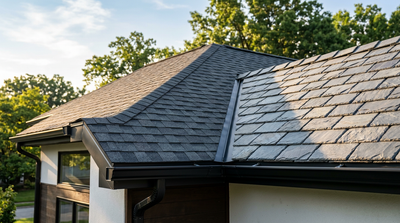
A professionally installed metal roof lasts 40 to 70 years depending on the material, panel engineering, and local climate. Premium standing seam systems utilizing Galvalume steel or aluminum coated with high-grade PVDF paint can comfortably exceed 60 years of service life. Conversely, lower-tier exposed-fastener (corrugated) systems typically last 20 to 30 years.
Why the massive 40-year difference? It comes down to one tiny component: rubber. The lifespan of exposed-fastener roofs is fundamentally dictated by the 10-to-15-year degradation cycle of the exposed rubber washers sealing their thousands of screws. When the rubber cracks, water enters. In contrast, standing seam roofs hide their fasteners entirely, protecting them from the elements and allowing the metal to achieve its maximum engineered lifespan.
- Concealed vs. Exposed: Standing seam roofs (concealed fasteners) last 50-70+ years, while exposed fastener roofs last 20-30 years due to weathering of the rubber screw seals.
- Maintenance is Mandatory: Exposed-fastener roofs are not "set-and-forget." Manufacturer specifications dictate that their rubber-gasket screws must be inspected and systematically replaced every 10 to 15 years to prevent leaks.
- Material Matters: Coastal environments require marine-grade aluminum or copper, as standard galvanized steel will rapidly oxidize (rust) from airborne salt.
Editorial Transparency: ProductLifespans is an independent consumer education platform. Our editorial content is supported by advertising, and advertising does not determine our research findings or recommendations. All material lifespan metrics, chemical degradation timelines, and structural wind ratings in this article are derived from Metal Construction Association (MCA) guidelines, ASTM international testing standards, and professional roofing field data.
The Metallurgy of Longevity: Standing Seam vs. Exposed Fastener
When calculating the return on investment (ROI) of a metal roof, you must first understand the fundamental engineering difference between the two primary panel designs. The physical durability and lifetime expectations vary wildly based on how the panels are attached to your roof deck.
1. Standing Seam Systems (Concealed Fasteners)
According to industry standards set by the Metal Construction Association, standing seam roofs have an expected lifespan of 50 to 70+ years when made of steel or aluminum, and can exceed 100+ years when fabricated from copper or zinc.
The engineering advantage here is complete elemental protection. Fasteners are entirely hidden beneath the overlapping metal panels and anchored to the roof deck using sliding metal clips. This protects the screws from ultraviolet (UV) sunlight exposure, acid rain, and wind. Furthermore, these sliding clips accommodate thermal movement—they allow the metal panels to expand and contract freely as they heat up in the sun and cool down at night, without stressing the structural joints.
2. Exposed Fastener Systems (Through-Fastened / Corrugated)
Manufacturer specifications generally rate exposed fastener systems for a lifespan of 20 to 30 years.
Their major engineering limitation is right in the name: panels are directly screwed through the metal face straight into the roof decking. This leaves thousands of screw heads exposed to environmental elements. While the metal sheets themselves could hypothetically survive for 50 years, the EPDM (Ethylene Propylene Diene Monomer)—a highly durable synthetic rubber—washers that seal these screw holes are the weak link. Field repair data consistently shows that EPDM washers degrade, crack, and shrink within 10 to 15 years. Once they fail, water flows directly into the roof decking.
3. Material Science Comparison
The core metal you choose dictates how your roof reacts to moisture, salt, and oxygen.
- Galvalume Steel (ASTM A792): This steel is coated with a specific alloy consisting of 55% Aluminum, 43.4% Zinc, and 1.6% Silicon. Think of it as an armored shield that also heals itself. If the metal is scratched, the zinc sacrifices itself to seal the wound, preventing rust at cut edges. It offers superior barrier protection in most climates.
- Galvanized Steel (ASTM A653): Coated in pure zinc, this material offers good protection but is more susceptible to "edge creep" (rust spreading from the cut edges) and pitting in high-moisture or acidic environments compared to Galvalume.
- Aluminum (ASTM B209): Because aluminum does not contain iron, it is completely immune to red rust. This is the baseline industry standard for coastal properties located within 1,500 feet of salt water, as the salty marine atmosphere will rapidly oxidize (rust) steel panels.
- Architectural Copper & Zinc: These metals naturally form a protective patina—a superficial layer of oxidized green or brown film that acts as a permanent, self-healing shield. They are virtually impervious to atmospheric corrosion and routinely last over a century.
4. Paint and Coating Systems (PVDF vs. SMP)
The color of your roof isn't just cosmetic; it is a vital chemical barrier against the sun.
- PVDF (Polyvinylidene Fluoride / Kynar 500): This is a highly resilient, premium resin formulation. It is exceptionally resistant to UV radiation, chalking (when paint turns to a white, powdery residue), and color fading. PVDF maintains its structural film integrity for 30 to 40 years, making it the manufacturer-recommended choice for high-UV climates.
- Silicone-Modified Polyester (SMP): A more budget-friendly coating. While it is physically harder and more scratch-resistant than PVDF, its chemical bonds break down faster under UV light. This leads to visible color fading and micro-cracking over 15 to 20 years.
Key Failure Points: What Prematurely Destroys a Metal Roof?
While metal roofs are highly durable, they are not invincible. Premature degradation is usually triggered by chemical reactions or basic physical movement rather than the failure of the metal itself.
| Recommendation / Claim | Confidence Level | Primary Source Type |
|---|---|---|
| Standing Seam Lifespan (50-70 Yrs) | HIGH | Industry Standards (MCA) |
| Exposed Fastener Lifespan (20-30 Yrs) | HIGH | Manufacturer Specs |
| EPDM Washer Degradation (10-15 Yrs) | MEDIUM | Field Repair Data |
| Synthetic Underlayment Lifespan (50+ Yrs) | LOW | Extrapolated Lab Tests |
1. Galvanic Corrosion (Dissimilar Metal Reactions)
Galvanic corrosion is an electrochemical reaction that occurs when two different types of metal touch each other while wet. Think of it like a car battery: the water acts as an electrolyte (the fluid connecting the circuit), causing the weaker, less "noble" metal to rapidly dissolve and corrode to protect the stronger metal.
In the real world, this happens if a homeowner uses copper runoff pipes from an air conditioner, or installs copper flashing directly over steel or aluminum panels. It also occurs if carbon steel screws are accidentally used on Galvalume panels. The result? Rapid, localized pinholing (tiny holes eaten completely through the metal) and catastrophic structural failure of the panels within 3 to 7 years.
2. Thermal Expansion Fatigue
Metals expand and contract significantly with daily temperature swings. Aluminum, for instance, has a high coefficient of linear expansion ($23 \times 10^{-6}/^\circ\text{C}$). In plain English, this means that on a 30-foot roof panel, the shift from winter cold to intense summer heat causes the metal sheet to literally grow and shrink by up to 0.7 inches.
If you have an exposed fastener roof, the panels are pinned tightly to the wood beneath them. As the metal aggressively expands and shrinks every single day, it pushes against the stationary screws. Over decades, this "wallows out" (stretches and enlarges) the screw holes, creating a gap where water can easily flow inside. Just as understanding thermal cycling is crucial for knowing how long a refrigerator lasts due to compressor strain, managing temperature fluctuations is vital for metal roof longevity.
3. Fastener Torque Errors
The exact tightness (torque) of the screws on an exposed fastener roof dictates how long the roof remains waterproof.
- Under-tightened Screws: The EPDM rubber gasket is not compressed enough to seal the hole. Water gets drawn in through a process called capillary action (where water naturally climbs into tiny, tight spaces).
- Over-tightened Screws: If the installer drives the screw too hard, the pressure crushes and splits the EPDM washer outward. This exposes the torn rubber to accelerated UV cracking and ozone degradation, leading to guaranteed leaks within 5 years.
4. Organic Debris and Acidic Runoff
Accumulations of leaves, pine needles, or dirt in the valleys of your roof or behind chimneys act like a wet sponge. As this organic matter decays, it creates organic acids that drop the pH of rainwater runoff below 5.0. This mildly acidic solution slowly eats away the protective zinc or aluminum coating, leaving the raw iron core of steel panels exposed to rapid rusting.
Preventative Maintenance Protocols to Maximize Lifespan
To ensure your metal roof reaches its maximum engineered service life, practical consumer experience and manufacturer manuals agree on a structured maintenance routine.
- Semi-Annual Inspections (Spring & Fall): Clear your valleys and gutters of all organic material, twigs, and leaves to prevent moisture pooling and localized acidic corrosion.
- Check Penetration Sealants: Inspect the silicone or polyurethane sealants applied around pipe boots (plumbing vents), solar mounts, and chimney flashings. These sealants typically dry out and degrade within 10 to 15 years and must be scraped away and reapplied.
- Perform Fastener Integrity Audits (Exposed Fastener Systems Only): Every 5 years (starting at Year 10), inspect individual screw heads to see if they are backing out, rusting, or if the rubber EPDM washers have split or gone missing.
- Replace Degraded Fasteners: When you find cracked washers, remove the old screw and replace it with a slightly oversized diameter "repair screw" equipped with a fresh, UV-stabilized EPDM washer to tightly grip the slightly expanded hole.
- Annual Coastal Washdowns: If you live within 1 mile of saltwater, perform an annual freshwater washdown. This removes accumulated crystalline sodium chloride (salt) that causes accelerated rust at panel edges.
- Gentle Algae Cleaning: Clean localized biological growth using a low-pressure wash (under 1,000 PSI) and a mild solution of trisodium phosphate (TSP) or laundry detergent. Never use wire brushes or abrasive pads, which permanently scratch protective paint coatings.
Irreversible Failure Signals: When to Replace Your Metal Roof
There comes a point where a metal roof transitions from needing maintenance to requiring total replacement. Here are the critical indicators that your roof has reached the end of its life.
Warning - Structural Substrate Perforation (Red Rust): If oxidation has eaten completely through the steel panel substrate—either from poor under-panel ventilation causing underside condensation, or top-surface decay—it cannot be patched. If more than 10% of the roof surface exhibits deep red rust and perforation, complete panel replacement is required.
Systemic Wallowed Fastener Holes
In exposed fastener roofs, decades of thermal movement can enlarge screw holes to the point where even oversized repair screws can no longer bite securely into the wood decking or seal the gap. If you notice that metal panels can be lifted by wind or begin to violently rattle during storms because the fastener holes have elongated into slots, the system's wind uplift rating is totally compromised and must be replaced.
Widespread Coating Adhesion Failure
According to ASTM D4214 testing standards, coating failure is characterized by widespread peeling, flaking paint, or heavy chalking. Once the bare metal substrate is systematically exposed to UV rays and atmospheric moisture without its protective barrier coat, raw oxidation will soon follow. If the metal thickness is still perfectly intact, a professional can sometimes recoat the roof. If rust has set in, it requires replacement.
Underlayment Degradation and Substrate Rot
Continuous structural leaks resulting from dry-rotted underlayment or soft, decaying plywood decking underneath the metal sheets signify a major failure. If the underlying structural deck loses its load-bearing capacity, the metal panels must be entirely detached, the rotted decking replaced, and fresh high-temperature synthetic underlayment installed before putting new panels down.
"Longevity Lab" Pro-Tips for Maximizing ROI
If you are planning a new roof installation, these data-backed specifications will help optimize lifetime performance and minimize your total cost of ownership.
Pro-Tip: Insist on High-Temperature Synthetic Underlayment
Metal roofs conduct heat exceptionally well. Under-panel temperatures can reach a staggering 80°C (176°F) during peak summer afternoons. Standard organic felt underlayment (traditional black tar paper) dries out, becomes brittle, and disintegrates under these extreme temperatures. Always specify premium, self-adhering, high-temperature polyolefin/polypropylene synthetic underlayment rated to withstand temperatures up to 120°C (250°F).
Pro-Tip: Specify Floating Clips for Long Panel Runs
For standing seam roofs where continuous panels exceed 30 feet in length, massive thermal expansion forces will cause oil canning (a cosmetic defect where the metal buckles and looks wavy) or severe structural stress if standard fixed clips are used. Require the installer to use two-piece "floating" or "sliding" clips. These ingeniously designed clips allow the metal panels to slide, expanding and contracting up to 2 inches independently of the structural roof deck.
Match the Metal to Your Microclimate
Standard materials perform drastically differently depending on environmental factors. Ensure you specify the correct metal for your region:
- High-UV Desert Regions: Choose a light-colored PVDF-coated Galvalume. This maximizes solar reflectance, significantly lowering cooling costs, and protects the roof against extreme color fading.
- Coastal Regions (Within 1,500 ft of saltwater): Avoid steel entirely. Specify 0.032" or 0.040" marine-grade aluminum (ASTM B209) or copper to prevent rapid saltwater oxidation.
- High-Impact Hail Zones: Opt for a Class 4 impact resistance rating under UL 2218 testing standards. This generally means selecting a thicker, 24-gauge steel panel over softer aluminum panels to prevent severe denting.
FAQ: Common Questions on Metal Roof Lifespan
Does a metal roof last longer than architectural asphalt shingles?
Yes. Premium standing seam metal roofs last 50 to 70 years, which is 2 to 3 times longer than high-end architectural asphalt shingles (which typically last 18 to 25 years under optimal conditions).
How often do you have to replace the screws on a metal roof?
On an exposed fastener metal roof, the neoprene or EPDM rubber washers seal against water intrusion but typically degrade under UV light and thermal stress in 10 to 15 years. Plan to systematically inspect and replace these fasteners during this window to prevent leaks. Standing seam systems hide fasteners completely, eliminating this maintenance step.
What is the wind resistance rating of a metal roof?
High-quality standing seam systems are engineered to withstand extreme wind conditions. When installed according to UL 580 Class 90 standards, metal roofs can withstand winds up to 140 mph without panel uplift or structural failure.
Will hail ruin a metal roof?
No, metal roofs are highly durable against blunt impacts. Most structural steel metal roofs carry a UL 2218 Class 4 impact rating, meaning they can withstand 2-inch steel balls dropped from 20 feet without cracking or puncturing. While large, severe hail may cause cosmetic dimpling, it rarely breaches the structural water-tightness of the metal panels.
Official Standards & Authoritative Sources
To ensure structural safety, material compliance, and aesthetic longevity, our data references the following manufacturing guidelines and international standards:
- ASTM A792 / A792M: Standard Specification for Steel Sheet, 55% Aluminum-Zinc Alloy-Coated (Galvalume) by the Hot-Dip Process. astm.org
- ASTM B209: Standard Specification for Aluminum and Aluminum-Alloy Sheet and Plate. astm.org
- ASTM D4214: Standard Test Methods for Evaluating the Degree of Chalking of Exterior Paint Films. astm.org
- UL 580: Standard for Tests for Uplift Resistance of Roof Assemblies. ul.com
- UL 2218: Standard for Impact Resistance of Prepared Roof Covering Materials. ul.com
- Metal Construction Association (MCA): Technical resources and certification guidelines for metal roofing systems. metalconstruction.org

David Mercer is the Lead Analyst at ProductLifespans.com. With over 10 years of hands-on experience reviewing hardware durability, home appliance mechanics, and total-cost-of-ownership economics, David specializes in translating complex manufacturer specs into practical repair-vs-replace guidance. When he isn't analyzing lifecycle data, he's testing consumer equipment durability in his home workshop.