How Long Does Salmon Last in the Freezer? Safety Guide

Table of Contents
Raw salmon retains peak quality in a domestic freezer at 0°F (-18°C) for 2 to 3 months when stored in a standard zipper-lock bag, according to standard USDA guidelines. However, if you are wondering how long salmon lasts in the freezer from a pure safety standpoint, the answer is indefinite. As long as the fish is kept continuously frozen at or below zero degrees, bacterial and parasitic activity is completely suspended, rendering it biologically safe to eat.
While the salmon will not make you sick after a year in the freezer, its culinary quality will dramatically decline. Over time, chemical reactions like lipid oxidation and physical changes like ice crystal sublimation (freezer burn) will strip the fish of its moisture, flavor, and vibrant color. Fortunately, with commercial-grade packaging methods like vacuum sealing, you can extend the peak sensory lifespan of frozen salmon up to 12 months.
- Quality vs. Safety: Raw salmon tastes best when consumed within 2 to 3 months of home freezing, but it remains safe to eat indefinitely at 0°F (-18°C).
- The Vacuum-Thaw Trap: You must puncture or remove airtight vacuum packaging before thawing salmon in the refrigerator to prevent the growth of dangerous, toxin-producing bacteria.
- Packaging Dictates Lifespan: Upgrading from standard thin plastic bags to vacuum-sealed pouches or utilizing ice-glazing techniques can extend premium quality from 3 months to a full year.
Editorial Transparency: ProductLifespans is an independent consumer education platform. Our editorial content is supported by advertising, and advertising does not determine our research findings or recommendations. All biological storage timelines, safety thresholds, and pathological data in this article are derived from official USDA Food Safety and Inspection Service guidelines, FDA Hazard Control manuals, and the ASHRAE Handbook of Refrigeration.
Direct Answer: Storage Timelines & Biological Safety
When assessing how long salmon lasts in the freezer, consumers must separate culinary quality from microbiological safety. This distinction often leads to confusion over expiration dates. The United States Department of Agriculture (USDA) explicitly states that any food stored continuously at 0°F (-18°C) will always be safe to eat. At this temperature, the water inside the food is locked into a solid state, depriving bacteria, molds, and yeasts of the moisture they require to multiply.
However, safety does not guarantee a pleasant dining experience. The USDA's FoodKeeper App recommendations prioritize optimal flavor, texture, and nutritional retention over absolute spoilage limits. Because salmon is a fatty fish—rich in delicate polyunsaturated fatty acids—it degrades faster in frozen storage than lean white fish like cod or halibut.
If you choose to freeze cooked salmon leftovers, note that the structural changes from the cooking process actually reduce its freezer lifespan. The heat renders the fats more volatile and susceptible to absorbing off-odors from the freezer environment. If you frequently meal-prep and store various cooked meats, you might notice that seafood requires faster consumption than poultry or beef; for context, understanding how long cooked steak lasts in the fridge or freezer reveals that dense red meats generally withstand cold storage degradation slightly better than delicate seafood.
| Salmon Type & Packaging | Peak Quality Lifespan | Biological Safety Lifespan |
|---|---|---|
| Raw Salmon (Vacuum-Sealed / Flash-Frozen) | 8 to 12 Months | Indefinite (at or below 0°F) |
| Raw Salmon (Standard Domestic Zipper Bag) | 2 to 3 Months | Indefinite (at or below 0°F) |
| Cooked Salmon (All Packaging Types) | 1 to 2 Months | Indefinite (at or below 0°F) |
The Science of Sub-Zero Fish Degradation
Even though bacterial growth stops at zero degrees, physics and chemistry do not. Four distinct scientific processes continuously degrade the quality of your frozen salmon over time.
Lipid Oxidation in Omega-3 Fatty Acids
Salmon is prized for its high concentration of Omega-3 polyunsaturated fatty acids (PUFAs). However, these specific fat molecules are highly unstable. Even at sub-freezing temperatures, if any oxygen is present inside the packaging, it will chemically react with these fats. This process is called lipid oxidation. You can think of it like iron rusting; the oxygen attacks the molecular structure of the fat, causing it to turn yellow, sour, and rancid. This chemical "rusting" is the primary reason fatty fish have shorter freezer lives than lean fish.
Ice Crystal Sublimation (Freezer Burn)
Modern household freezers are designed to be extremely dry environments. Through a process called sublimation, water molecules on the surface of the salmon transition directly from a solid state (ice) into a gas (water vapor) without ever melting into liquid first. As the moisture leaves the fish to enter the dry freezer air, it leaves behind dehydrated, woody, paper-like patches on the flesh. This irreversible cellular dehydration is commonly known to consumers as freezer burn.
Myofibrillar Protein Denaturation
The structural framework of salmon muscle is primarily composed of two myofibrillar proteins: actin and myosin. When fish is frozen slowly in a standard kitchen freezer, large ice crystals form. These massive crystals physically crush and unwind (denature) the proteins. Once unwound, the proteins clump together and lose their ability to act like a sponge. When you eventually thaw the salmon, it will not be able to reabsorb its own moisture, resulting in a dry, spongy, and fibrous texture upon cooking.
TMAO Degradation and Odor
Saltwater fish naturally contain a compound called Trimethylamine Oxide (TMAO), which helps them balance the salt content of the ocean water in their cells. Over extended frozen storage, slow-acting enzymes gradually break down TMAO into trimethylamine (TMA) and dimethylamine. TMA is the exact chemical responsible for that intensely pungent, stale "fishy" aroma. While harmless to ingest, high TMA levels ruin the flavor profile of the salmon.
The Vacuum-Sealing Thaw Trap & Pathogen Safety
CRITICAL SAFETY WARNING: Never thaw vacuum-sealed salmon in the refrigerator without puncturing the plastic first.
Marine environments naturally harbor Clostridium botulinum Type E, a psychrotrophic (cold-loving), non-proteolytic pathogen. Unlike other bacteria, Type E can grow and produce lethal neurotoxins at temperatures as low as 38°F (3.3°C). Crucially, this bacteria is anaerobic—it thrives only when oxygen is completely removed.
If you take a vacuum-sealed piece of salmon from the freezer and place it directly into the refrigerator to thaw, you create a perfectly cold, oxygen-depleted incubation chamber. The bacteria can germinate and produce botulinum toxin before the fish exhibits any foul smells or signs of spoilage. To neutralize this threat, you must slice open or entirely remove the vacuum packaging before placing the fish in the fridge. Introducing normal atmospheric oxygen completely inhibits the toxin production.
Step-by-Step Protocols to Maximize Freezer Lifespan
To extend the shelf life of raw salmon from a mere 2 months to a full 12 months, you must manipulate the freezing speed and eliminate oxygen exposure.
Rapid Freezing & The Thermal Arrest Zone
When freezing food, temperature drops rapidly until it hits 32°F (0°C). Then, the temperature drop stalls—this is known as the Thermal Arrest Zone (between 32°F and 25°F / 0°C and -4°C). This is the window where water transitions into solid ice. If your salmon stays in this temperature zone for too long, the water molecules have time to gather together and form massive, jagged extracellular ice crystals that puncture the delicate cell walls of the fish.
Upon thawing, these ruptured cells leak out their liquid—a phenomenon called drip loss—taking all the flavor and moisture down the drain. To traverse the thermal arrest zone rapidly, cut your salmon into smaller portions, ensure they are chilled in the fridge first, and place them in the coldest, deepest part of the freezer against an interior wall.
Commercial-Grade Packaging Methods at Home
Oxygen and dry air are the enemies of longevity. You must create an impermeable barrier.
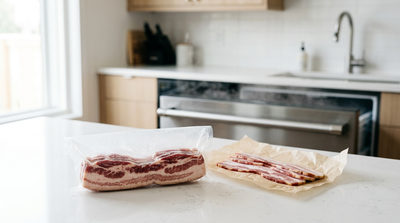
- Vacuum Sealing: The gold standard. By mechanically evacuating all air from heavy-duty plastic, you entirely prevent both lipid oxidation and ice crystal sublimation.
- The Water-Displacement Method: A budget-friendly alternative. Place your salmon in a standard zipper bag. Submerge the bag in a large bowl of water, keeping the unsealed zipper just above the water line. The pressure of the water will squeeze the residual air out of the bag, wrapping the plastic tightly against the fish. Seal the bag just before pulling it out of the water.
The Ice Glazing Protocol (For Bulk Buyers & Anglers)
If you catch whole salmon or buy large quantities without a vacuum sealer, the industry-standard "ice glazing" method provides an exceptional sacrificial barrier against freezer burn.
- Step 1: Place unwrapped salmon fillets on a parchment-lined baking sheet and freeze them solidly for 2 hours.
- Step 2: Prepare a bowl of ice water (near 32°F / 0°C).
- Step 3: Remove the frozen salmon and quickly dip it into the ice water for 3 to 5 seconds.
- Step 4: Place the salmon back in the freezer for 10 minutes. The residual water will instantly freeze into a thin sheet of ice.
- Step 5: Repeat this dipping process 3 to 4 times until a thick, continuous ice shell forms over the entire fish.
- Step 6: Wrap the glazed fish securely in freezer paper or a plastic bag. The ice shell will sublimate (evaporate) over the next year instead of the fish tissue.
Pro-Tip: Appliance Selection Matters
Most modern kitchen freezers are "Auto-Defrost" (Frost-Free). To prevent ice buildup on the walls, they activate a small heating element every 8 to 12 hours. This slightly warms the internal temperature, causing microscopic melting and refreezing on the surface of your food. Over time, this temperature fluctuation accelerates cell damage and freezer burn. For long-term preservation of high-value seafood, a "Manual-Defrost" deep chest freezer is superior. Because it maintains a constant, uninterrupted -10°F to 0°F temperature, vacuum-sealed salmon can easily retain peak quality for up to 12 months.
Diagnostic Checklist: Has Your Frozen Salmon Spoiled?
If you uncover a mystery package of frozen salmon at the bottom of your chest freezer, use these sensory diagnostics to determine if it is still worth cooking. Much like evaluating highly perishable cured meats—such as knowing how long ham lasts in the fridge before spoiling—seafood requires strict adherence to sensory cues.
- Visual Indicators: Inspect the frozen flesh for severe white, grey, or paper-thin dry patches. Minor spots of freezer burn can be trimmed away with a knife, but if the entire fillet is covered, the texture will be unpalatably woody. Additionally, look for a dulling of the signature vibrant pink or orange color into a faded, yellowish-brown hue, indicating severe lipid oxidation.
- Tactile Post-Thaw Signals: Once fully thawed (in the refrigerator with an opened package), check the surface texture. Freshly thawed salmon should feel damp and firm. If it feels excessively slimy, sticky, or tacky to the touch, bacteria may have begun proliferating before it was originally frozen. Assess the firmness: a mushy, easily disintegrated structure that falls apart under light finger pressure indicates severe cell rupture and massive drip loss.
- Olfactory Warnings: Thawed raw salmon should smell remarkably neutral, like fresh ocean water. Sniff closely for strong sour, ammonia-like, or heavily rancid odors. If a sharp chemical smell persists even after rinsing the thawed fish with cold water, it has degraded beyond culinary acceptability and should be discarded.
If you determine the fish is still safe and proceed to thaw it, remember that thawed seafood is highly perishable. It must be cooked quickly, similar to the tight timelines required when monitoring how long tuna lasts in the fridge once brought home from the market.
Frequently Asked Questions
Is frozen salmon safe to eat after 1 year?
Yes. According to the USDA Food Safety and Inspection Service, frozen salmon stored continuously at 0°F (-18°C) or below remains safe to eat indefinitely because low temperatures completely halt the growth of bacteria and pathogens. However, after one year, the sensory quality will have degraded significantly due to lipid oxidation and freezer burn, resulting in a dry, fibrous texture and potential off-flavors.
Should you remove vacuum packaging before thawing frozen salmon?
Yes. You must cut open or entirely remove the vacuum-sealed packaging before thawing salmon in the refrigerator. Leaving it sealed creates an oxygen-free (anaerobic) environment. If the refrigerator temperature rises above 38°F (3.3°C), it allows Clostridium botulinum Type E spores to germinate and produce dangerous, tasteless neurotoxins before the fish spoils.
Does freezing salmon kill parasites?
Yes, but standard home freezers are generally not cold enough to guarantee rapid parasite destruction. According to FDA guidelines, to reliably destroy parasitic worms (such as nematodes), fish must be frozen to -4°F (-20°C) or below for a continuous 7 days, or subjected to commercial blast freezing at -31°F (-35°C) for 15 hours. Most domestic freezers operate right at 0°F (-18°C), which suspends parasite activity but may not definitively kill them in short timeframes.
Can you safely refreeze salmon that has been thawed?
Yes, but only under strict conditions. If the raw salmon was thawed completely inside a refrigerator operating below 40°F (4.4°C) and was never left at room temperature, it is biologically safe to refreeze within two days. However, because freezing ruptures cell walls, a second freeze-thaw cycle will dramatically increase drip loss, rendering the fish noticeably drier and mushier upon the second thawing.
Official Regulatory Standards and Technical References
- United States Department of Agriculture (USDA FSIS): Freezing and Food Safety Guidelines
- U.S. Food and Drug Administration (FDA): Fish and Fishery Products Hazards and Controls Guidance (Chapter 3 - Pathogens & Parasites)
- FoodSafety.gov: FoodKeeper Application Storage Timelines
- ASHRAE Handbook - Refrigeration (Section 31: Marine Products and Thermal Arrest Thermodynamics)

David Mercer is the Lead Analyst at ProductLifespans.com. With over 10 years of hands-on experience reviewing hardware durability, home appliance mechanics, and total-cost-of-ownership economics, David specializes in translating complex manufacturer specs into practical repair-vs-replace guidance. When he isn't analyzing lifecycle data, he's testing consumer equipment durability in his home workshop.